

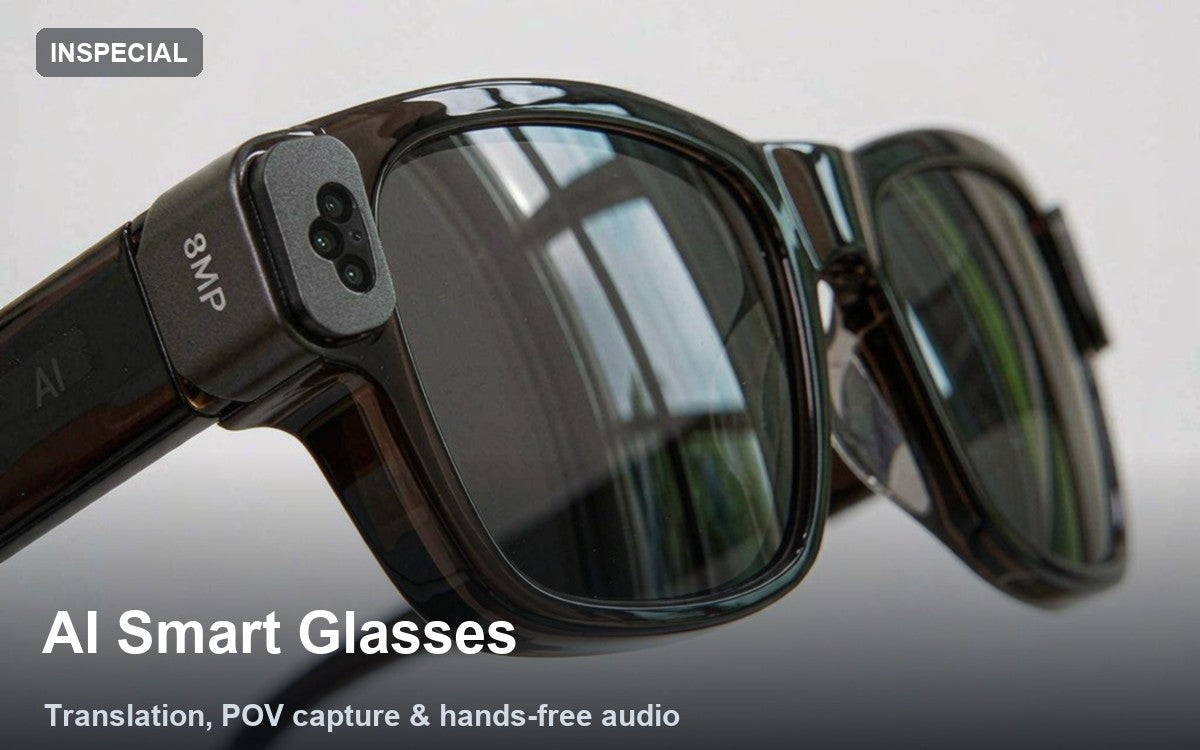
"Augmented" sounds like science fiction. In practice it looks much duller and far more useful: you stop taking your phone out of your pocket. Notifications arrive in your ear, the thing you're looking at gets recorded, and a menu in a language you don't speak turns into one you do — all without a device in your hands.
That's the actual category these products belong to. These are the 3 pairs in INSPECIAL's Tech augmented people collection, and they're not variants of the same idea — each one is built for a different job.
1. The Travel Pair: Translation Without the Phone
The most awkward part of travelling somewhere you don't speak the language isn't asking the question. It's the pause — the phone comes out, the other person waits, you squint at a screen and then hand it across a counter. It's slow and slightly dehumanising.
AI Smart Glasses with 8MP Camera – Real-Time Video Translation
The AI Smart Glasses with 8MP Camera – Real-Time Video Translation, Bluetooth Calling & Music attack that pause directly. The 8MP camera captures 1200P video, and the translation happens on what you're looking at — signage, a menu, the person in front of you — instead of on a handset you have to raise. Bluetooth calling and music are handled in the same frame, so it works as your everyday audio device too.
Practical notes: the value isn't the spec sheet, it's the flow. You keep eye contact, you keep your hands free for a bag or a boarding pass, and you stop anchoring every interaction to a screen. For frequent travel and for cycling — where a phone mount is a compromise and a handset is unsafe — that's the pair that earns its place.
Best for: travel, cycling, commuting, anyone who wants translation and capture in one wearable rather than two devices.
2. The Daily Driver: Eyewear You'd Wear Anyway
The failure mode of most smart glasses is that they look like smart glasses. You buy them, you use them for a fortnight, then they stay in a drawer because reaching for them feels like a decision.
HD UV-Resistant Smart Glasses – Bluetooth Eyewear with Camera, Music & Calling
The HD UV-Resistant Smart Glasses – Bluetooth Eyewear with Camera, Music & Calling, Polarized UV400 Protection are the answer to that problem at the lowest entry price in this collection. Polarized UV400 lenses mean you're getting real eye protection regardless of the electronics — if the battery dies you're still wearing a competent pair of sunglasses. Music and calling are handled over Bluetooth, and the camera is there for the moments you'd otherwise miss while fumbling for a phone.
This is the pair to buy if you want to test whether hands-free living actually suits you. It's the cheapest way into the category and the least conspicuous to wear.
Best for: everyday wear, driving, weekends — the pair that lives by the front door.

3. The Sport Pair: 8MP, Sun, and Long Sessions
Once you've used audio glasses outdoors you notice the compromise in normal ones: they're not built for sweat, glare or a two-hour ride.
8MP AI Smart Glasses MT5 – Bluetooth Sunglasses
The 8MP AI Smart Glasses MT5 – Bluetooth Sunglasses with Music, Calling & Translation, Polarized UV Protection are the top of this trio: an 8MP sensor, the same translation and calling feature set, and a polarized UV-protective frame in a proper sunglasses silhouette. Translation is the detail that separates it from a generic camera pair — on a trip or a long ride, being able to point at something and understand it without stopping is the whole point of the category.
Best for: outdoor training, long rides, holidays where you're in the sun all day and want one device instead of sunglasses plus camera plus earbuds.
Which Pair Is Yours?
- First smart glasses, lowest risk: the HD UV-Resistant pair at $123.76 — everyday glasses that happen to be smart.
- Most capability per dollar: the AI Smart Glasses with 8MP camera at $145.84 — translation, 1200P recording, calling and music.
- Sport and maximum features: the MT5 Bluetooth Sunglasses at $225.60 — 8MP, polarized, built for the outdoors.
Before You Buy: Wearing Them Well
Camera glasses put a small social responsibility on the wearer, and it's worth being deliberate about it:
- Recording laws vary. Some places require consent to record people, and some venues and workplaces prohibit wearable cameras entirely. Know the rule where you're standing.
- Say it out loud. A quick "I'm recording this, is that OK?" removes almost every awkward moment, especially in shops, gyms and private homes.
- Don't film strangers for content. The camera is for your own life, not for other people who didn't agree to be in it.
- They're not safety equipment. Open-ear audio keeps you aware of traffic, but treat every road and trail with the same caution you would with nothing in your ears.
The Augmented Everyday, In Practice
- Audio first. Whichever pair you pick, start by moving your daily podcasts, calls and music onto it. That builds the habit.
- Then capture. Record the thing you'd normally say "I wish I'd filmed that" about — a ride, a market, a recipe, a repair.
- Then travel with translation. The feature only pays off if you've already made wearing them automatic.
None of it is an implant, and none of it is a gimmick. It's just the phone, moved out of your hands and onto your face — which turns out to be where it should have been.
Shop the Collection
All three pairs come from INSPECIAL's Tech augmented people collection — smart eyewear for people who'd rather their hardware disappear into what they're already wearing. Browse the collection and pick the pair that matches how you actually spend your days.
Share:
The Sports-Parent Sideline Kit: Shade, Sanitation & Gear Hauling for Tournament Days
Beginner Weight Loss at Home: Your First 30-Day Starter Kit